
Is Meaningful Content Creation Possible?
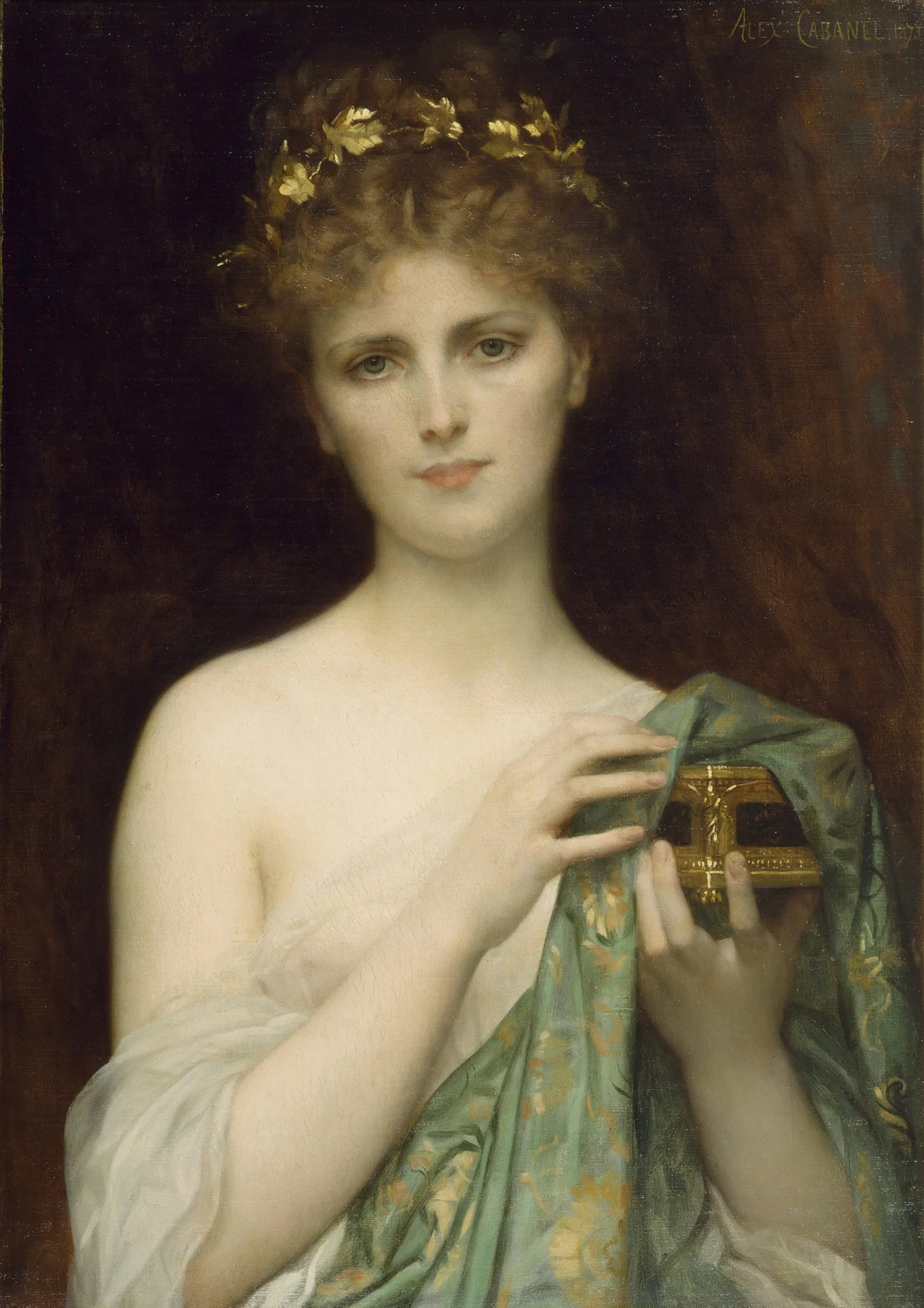
Pandora (1873), Alexandre Cabanel (French, 1823-1889)
Creating meaningful, fulfilling content is something I have been struggling with since I started my first YouTube channel in 2019. In theory, this is simple: know your values and create in a way that aligns with them; but in practice, the very platforms where we express ourselves can quickly interfere or distract us from that initial impulse.
I just went on a six months long hiatus from YouTube and Instagram, and it’s hard to express how relieving taking a break from social media can feel. I feel calmer, freer and feel better than I have in a long time – in fact, since my last break in 2024!
Despite the incredible relief this break brought me, the urge to share online has come back. It is with mixed feelings that I sat at my desk, opened a notebook and started jotting down video ideas; but before I could move forward, I had to reflect on content creation and social media.
The difference stepping away from it had made for me was too strong to ignore, which brought two questions: was I ready to get back to it, was there a way to share online while protecting myself from platform pitfalls? And can I morally share on platforms that I know can be so harmful?
Why It’s So Difficult to Create Content Sustainably
Despite the pitfalls, pressures and taxing aspects of being an online creator, I have to thank content creation for some of the best opportunities I ever had. It allowed me to improve as a person, meet many friends, and gave me the very job that allowed me to step back from YouTube.
Creation Context Can Change Everything
Six months ago, I started working for New Masters Academy. It has been an absolute joy and a relief on many levels, and it came as a direct result of the videos I created on my channel. A lot of what I do at New Masters Academy is a continuation of the content I was sharing on YouTube; but I feel very differently about it.
I have probably made over 200 videos over the years, and although I was proud of some of them, none gave me the sense of accomplishment I get from the presentations I put together for NMA. Since I started, everything I have created has felt like the best thing I ever shared: I feel more involved, excited, and prouder than I ever was on YouTube, which pushes me to keep improving.
This came as a surprise to me, and started my reflection on content creation: I am the same person, I write about the same topics, and I never intentionally « dumbed down » my social media content, so how can the outcome feel so different?
There are few factors I can identify:
• Optimisation: as much as I focused on bringing value to the viewer rather than pleasing the algorithm, hooks, audience retention, titles and thumbnails had to be on my mind at every stage, and this is brain power taken away from the actual content;
• Compromises: because video and channel visibility depend on video’s performance, I was making compromises, consciously or not; favouring popular topics, trimming content down, choosing the catchy angle rather than the educational one;
• Financial pressure: building a business that relies on my online presence significantly worsens the effects of the two previous points.
Some creators seem to manage these challenges really well. As someone who has reflected on it for years, I thought I was one of them, but recent evidence showed me that I was wrong.
How Platforms Train Candy Makers
We are all aware of the negative effects of social media on users: how they take up our time, affect our attention and self esteem, and most of all, how addictive they are. Infinite scrolling, algorithms, rewarding systems are all built to keep people engaged for as long as possible, and coming back as often as possible.
But an important part of making your platform addictive is to have addictive content. This is best achieved with highly stimulating, widely popular, and rather shallow content; what I like to think about as content candy. It will give you instant gratification, keep you reaching out for more, develop your sweet tooth, and doesn’t have much nutritive qualities.
With thoughtfully designed features and reward systems, platforms train users to become candy addicts, and creators to become candy makers.
This happens through multiple effects:
• Numbers of likes and subscribers are psychological rewards. As people get more and more used to very catchy and stimulating content, the need for stimulation increases and content performs better when leaning towards that type of content. We naturally adjust our behaviour to get the reward.
• Sugar is cheap. It takes thinking, effort and time to create original content of deeper value: expensive stuff. On the other hand, although making candy content is labor intensive, recipes are well known, ingredients simple, and machines can automate the process.
• We’re all getting cavities. The worse effects of social media include a reduced attention span, fragmented thinking, and scrolling addiction taking you away from deeper work; all of which are especially harmful to creation. This is often called brain rot, but I’ll go for « cavities » to suit my metaphor… The point is that because it is hard to create content without participating on the platform, creators get those as well. When your ability to think deeply is impaired, and you have a higher need for instant gratification and rewards, it affects what you create negatively.
• It’s a business. Beyond psychological rewards and traps, for many creators, content performance affects the feasibility of their creations, their current or future income, or even their livelihood. This concrete pressure multiplies the effects of previous points.
And there’s certainly more. So the question is: how can we protect ourselves against these effects? Is it possible to prevent cavities and resist the incentive to create candy-like content?
The Right Kind of Prevention
Personal responsibility is something I deeply value, but the most important point I want to make is: cavities are not your fault. This matters for two reasons.
• It’s true. Personal responsibility starts when we make a choice, and the ability to choose comes from an understanding of the situation. But we are surrounded by highly addictive devices. People are getting exposed from childhood, and smartphones are becoming necessary for essential daily activities. There are no regulations or deeply internalised social disapproval around them to safeguard us. Online platforms are designed to alter our behaviour by highly capable people; we can educate ourselves as much as we want, I don’t think any individual is up to the task. And it’s okay.
• It’s helpful. Although my previous point might seem discouraging, placing personal responsibility where it belongs is the only way to make the right kind of adjustments. Beating ourselves up for something we’re not responsible for is the best way to remain trapped; understanding the trap is the first step to getting out and staying away.
In the domain of habit formation, there is an emphasis put on environment design versus self control. We tend to put a lot of importance in self-discipline: believing some people have more of it, that it is the most important characteristic to succeed… This naturally leads us to perceive failure to change some habits as a character flaw or even a personal failure. However, it turns out that when it comes to behaviour change, environment design is more effective than self discipline. Making things easier for yourself is more effective than working harder.
This is especially relevant to social media and smartphone use because the addiction was created by design, and the way to protect ourselves against their damaging effects relies on environment design, not self control.
This means:
• For social media users (including content creators): the best prevention is to reduce exposure by reversing every aspect that has made it so addictive in the first place. Remove notifications, break social media’s omnipresence by only accessing them from a computer, make your smartphone less rewarding by deleting gratifying apps, less visible by keeping it in a drawer rather than constantly in your field of view, replace as many of its functions as possible with other objects to reduce your exposure to temptation... Take all the measures that best apply to your situation. There is no self control involved, just environment changes; it may be uncomfortable at first, but this will pay off sooner than you think, when you regain your time, your focus, and most importantly, your agency.
• For content creators: improving your attention span, getting out of the fragmented thinking smartphone use induces, regaining the ability to focus deeply will have an impact on the quality of your creations. Reducing your dependency on instant gratification will improve your endurance, and make the creative work more enjoyable. As you distant yourself from it, you will be less influenced by mainstream content. But to reduce the effects of creative incentives, you must also work on the back end: set limits (actual barriers or blockers, remember to rely on environment design, not self control!) for when and for how long you check statistics or hide them altogether, reframe your idea of success around authenticity rather than metrics, have someone you trust filtering comments… Remember that you are going against the grain of a platform that is infinitely more powerful, so monitor yourself and your content closely and frequently to make sure you are still aligned with your goals, not theirs.
As far as I know, this is what it takes to create content sustainably: to protect yourself and keep your content as closely aligned with your personal values as possible.
However, this doesn’t answer my other question: if platforms are so harmful, isn’t the right thing to leave them altogether?
Can We Morally Share Content on Harmful Platforms?
Since 2019, my income has been closely tied to the success of my YouTube videos. It is after starting my first channel that my first business became successful, and all the projects I worked on since have relied on content creation to some degree. I started my current channel as part of my project to pivot from my previous business to art; and it helped me do exactly that.
I wanted to start by acknowledging the conflict of interest there is, when you are considering the morality of what makes your livelihood possible. I have been questioning the way I make content for years, and tried to keep some independence from platforms by building email lists, but I still depended on YouTube, and Instagram to some extent.
But now, for the first time since 2019, my income is completely detached from my online presence, and I am grateful to be able to think about it with more distance.
The Worse Thing About « Content »
The easiest way to perform on social media is to create content that plays on human’s lowest impulses. The worst part is that, as we get surrounded by attention grabbing, highly stimulating, gratifying content, we get used to it and our baseline adjusts.
It takes a more concentrated dose to get the same kind of reward, and what would have looked like a very attractive piece of candy a few years ago might now seem bland and go unnoticed in the middle of even more colourful candy.
Platform optimised content doesn’t simply play on human’s lowest impulses, but trains and worsens them.
From Shallow to Artificially Generated Content
Creating something original, coming up with a concept, exploring ideas with any depth and presenting them in a unique manner is a labor intensive, and inherently human activity. Creating optimised content that present existing ideas in a way designed to catch attention to be favoured by algorithm, following specific known guidelines, is also a lot of work; but it doesn’t have to be human.
Crafting content to fill a platform rather than share anything meaningful is in my opinion one of the most unpleasant activities for someone who genuinely loves creating; but AI can do it all day long.
There is nothing as unpleasant to me as stumbling on an AI generated image on Pinterest, or opening a YouTube video to realise it has been entirely generated from script to voice over. But AI generated content isn’t a new problem, just the logical consequence of the direction content creation has been following for many years.
When content quantity is prioritised over quality, catchiness over originality, gratification over depth, AI is more performant than humans. And by automating content creation, we give up the last of our creative skills. We are using algorithms to generate content that other algorithms will feed us, in a system that hooks us, reduces our ability to think and create, with the sole purpose of exposing us to as many ads as possible. This is something I felt strongly when ChatGPT first came out and I started playing with it, and the absurdity of it horrified me.
But despite all of this, some people keep creating deep, high quality, inspiring pieces of writing and videos that have a positive impact. Every time I discover one of them, I am glad social media exists, and inspired to create as well.
What Moral Content Could Be
It is important to understand the mechanisms of online platforms as much as possible, but that doesn’t mean nothing good can ever be done on them.
When I think about what would make content moral, it happens on different levels.
Moral Content Is Human
At the heart of all art and communication forms is connexion. What makes something we see, read or listen to valuable isn’t merely what it conveys, but the fact that it is conveyed from someone. When something has been created by another human being, we can feel connexion, relatedness, be challenged or inspired by it. This is a quality artificially generated content can only imitate, but the fundamental difference can never change.
Moral Content Is Authentic
Beyond coming from another human being, moral content is the closest reflection of that person’s values and beliefs, conveyed as truthfully as they can.
Moral Content Is Valuable
Sharing pieces of writing, videos or images has never been as easy as today. This is great, as it allows many people who wouldn’t have had a voice in the past to express themselves, but it also comes with a cost. The more convenient and cheaper the creation process, the lower the standard creations have to meet to come into existence. When a process is costly (think about laying out a book by hand), creations have to be worth it; today, we don’t have to think twice about what we put into the world. Moral content has to be valuable: it brings something, whether it is information, emotion, a message, individual expression…
Moral Content Is Ennobling
Content today is optimised to play on the worse aspects of human nature: instant gratification, entertainment, unchallenging and digestible ideas, constant stimulation… This type of content is hurting our ability to think critically, our attention span and even the capacity to think about anything for an extended period of time (fragmented thinking). On the opposite, moral content is something that would ennoble us: challenge us, enrich our ideas, give us something to think about, something we can even remember after we close the app.
To Share or Not to Share
No matter how long I weight the pros and cons of sharing online, I come back to this simple conclusion: I just want to do it.
The very fact that I keep thinking about it, the fact that you have read this is a proof of deep interest, and in my opinion, a sincere interest is not something to take lightly. Despite all of its downsides, my online presence has brought me some of the things I cherish most in my life today. Blogs and social platforms have exposed me to countless inspirations, and sparked that simple but deep feeling: I want to participate as well.
The challenge of creating content sustainably and with integrity will never disappear, but after thinking about this long and deep, I came to the conclusion that retracting myself from online presence doesn’t feel right. When I think about what would make me the most proud in five years, this isn’t to have left all social media, but rather to have kept striving to create and share something meaningful for whomever it resonates with.
Today’s internet landscape isn’t perfect, but maybe this is the strongest reason to stay and cultivate better spaces.
